


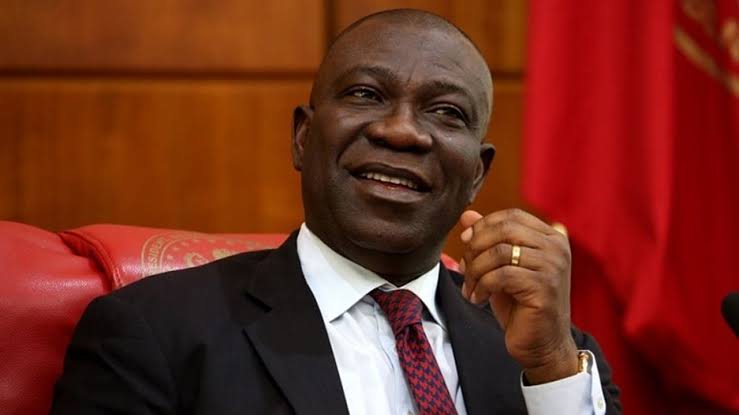
The Senator representing Enugu-West, Ike Ekweremadu has told the Independent National Electoral Commission (INEC) to revisit the Nigerian constitution and be guided on the subject of de-registering underperforming political parties.
In a statement, the Senator noted that INEC already has the constitutional power to de-register any political party in Nigeria that is not performing to a certain level.
Recall that the media reported the INEC saying that it has no constitutional powers to de-register any political party.
However, in the statement, the Senator said: I read a recent statement credited to INEC, Commissioner in charge of Nasarawa, Kogi, and Kwara States, Muhammed Haruna, that the electoral body could not de-register political parties without further constitution amendments. I also read another warning by INEC that the number of political parties could hit 200 by 2023.
INEC has a germane concern because the size of our political parties constitutes a logistical challenge to the election management body and identification problem to the electorate during elections. The ballots are getting too long and clumsy. It also has cost and time implications.
However, I believe INEC’s concern has already been substantially addressed by the 1999 Constitution as amended by the Eighth National Assembly and assented by President Muhammadu Buhari. INEC needs to look at the provisions of the Constitution of the Federal Republic of Nigeria, 1999 (Fourth Alteration, No. 9) Act published in Official Gazette No. 77 Vol. 105 to be well guided.
We inserted a new Section 225A, which provides that the INEC shall have the power to de-register political parties for breach of any of the requirements for registration and failure to win at least 25 percent of votes cast in one state of the federation in a presidential election or 25 percent of votes cast in at least one local government in a governorship election.
It further empowers INEC to de-register any party that fails to win at least one ward in the Chairmanship election or one seat in the National Assembly or State House of Assembly election or one seat in the Councillorship election.
What it means is that a political party may continue to exist. But once it appears on the ballot, it becomes compulsory for it to meet certain benchmarks to continue to exist.
So, of the 73 parties that fielded candidates for the 2019 presidential election, it is incumbent on INEC to de-register those that did not garner at least 25 percent votes in at one state.
It should also look at those that contested election in the states and de-register those political parties that did not poll up to 25 percent of votes in at least one local government area in those states they contested an election.
The same thing applies to local government and other elections. The idea is to encourage political parties to see the election as a serious democratic exercise and to confine themselves to the level of the election they have reasonable structures, support base, and resources to win or show substantial strength; otherwise, our elections will become unmanageable at a point.
Meanwhile, efforts to check the mushrooming of political parties started in 2010 in the Sixth National Assembly when an end was put the provision of subventions by INEC to political parties because many at the time were more interested in the monies than adding values to Nigeria’s democracy, ” he said.