


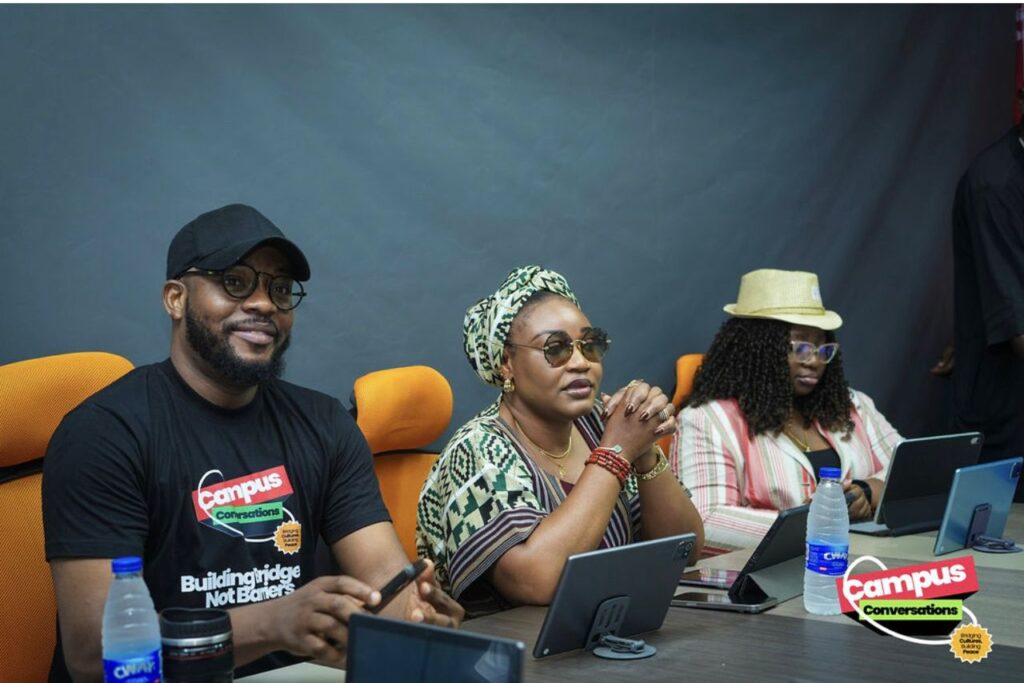
To drive a new narrative for a better Nigeria and ensure young people are active participants in the national development, PressPayNG recently assembled over 200 Nigerian students across the geopolitical zones in Abuja for a critical intervention in Nigeria’s evolving social architecture.
In a statement by the organisers titled: “Reframing Youth Engagement as a Strategic Peacebuilding Asset: Insights from the Peace Study Forum 2026”,the Peace Study Forum 2026, convened by PressPayNG and supported by the United Nations Educational, Scientific, and Cultural Organization (UNESCO) under its Intercultural Leadership Programme, was held at the Prixair Hotel, Abuja
Speaking at the Forum, the Founder/CEO of PressPayNG, Abiola Metilelu, stated that “The forum brought together over 200 students from across Nigeria’s six geopolitical zones. But beyond the numbers, what mattered was the composition: young Nigerians positioned not as passive participants in national discourse but as active architects of peace, championing the narrative for a better Nigeria.
“Because let’s be clear, Nigeria’s challenge is no longer just policy; it is perception. And perception, when left unmanaged, becomes conflict. What this forum achieved was a deliberate intervention at the level of narrative formation,” he added.
One of the keynote speakers, Petra Akinti Onyegbule, Head of Government Strategic Partnerships, was the former Chief Press Secretary to the former Governor of Kogi State, said, “This was not a one-day gathering but the culmination of a deliberate, three-month engagement model built on depth.
The initiative began with a structured virtual boot camp involving 50 students drawn from campuses nationwide. This was followed by a closed-door, in-person leadership and peacebuilding session for 25 participants on the morning of the forum, which I co-facilitated with Kehinde Charity Awujoola, Senior Special Assistant on Gender Matters to the Honourable Minister of Youth Development,” she stated.
This representation was significant, she said. The presence of the Honourable Minister for Youth Development at the forum, through his SSA on Gender Matters, reinforced the institutional importance of youth-led peacebuilding and positioned the initiative within the broader national youth development agenda.
“We engaged participants on practical competencies, dialogue facilitation, peer influence, conflict management, and most importantly, narrative responsibility. Because in today’s digital ecosystem, the loudest voice is not always the most informed, but it is often, unfortunately, the most influential.”
In my keynote address, “Nigeria’s Diversity, Ethnocentrism, and Peacebuilding: The Story That Divides Us and the Voices That Can Heal Us,” Onyegbule said, “I made one point clear: Nigeria’s divisions are not just structural; they are deeply psychological. We have normalised an ‘us versus them’ framework that continues to undermine national cohesion. Yet, if we are honest, progress in any meaningful sense will only emerge when we begin to think and act from a place of collective identity.
Peace is not a moral aspiration; it is a strategic necessity. No economy grows in instability. No investment thrives in uncertainty. No society develops in sustained tension,” she said.
From a strategic perspective, the link between social cohesion and economic outcomes is not theoretical, it is operational. Capital does not flow in a vacuum; capital follows stability. It follows trust. And it follows environments where risk is predictable and managed.
According to her, “What initiatives like this do is upstream work, they address the social conditions that ultimately determine whether economic systems succeed or fail. If young people are not equipped to manage diversity, engage constructively, and lead responsibly, then every intervention downstream, SME financing, agriculture value chains, digital inclusion, becomes harder, slower, and riskier.”
Speaking on the essence of the forum, Metilelu said, “So, no, this is not ‘just’ a youth forum. This is infrastructure. Soft infrastructure, but infrastructure nonetheless. What struck me most was not just the energy in the room, but also the intentionality.”
“Young people asking the right questions, listening, not to respond, but to understand, and leaning into uncomfortable truths about identity, leadership, and responsibility. And for me, this is where real leadership begins,” Onyegbule revealed.
“Credit must be given to Abiola Metilelu, CEO of PressPay Ng, whose vision for African students is not transactional, but transformational. He has demonstrated leadership by building platforms that outlive moments,” he commended.
The forum concluded with tangible outputs, a Peace Leadership Pledge, intercultural engagement commitments, and recognition of outstanding participants, including Olugbamiye Opeyemi Emmanuel of the Federal University Lokoja.